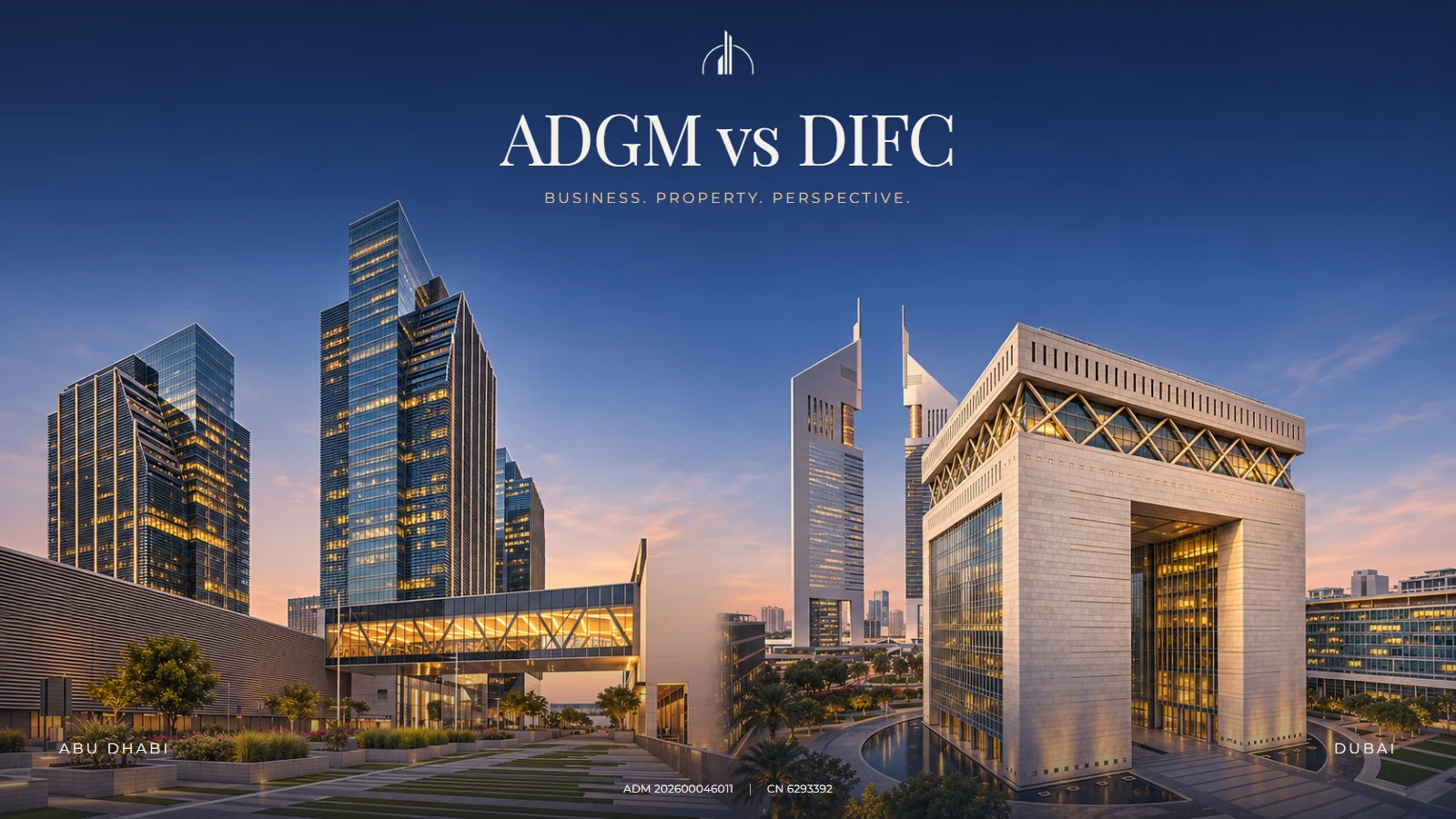
ADGM vs DIFC: A Practical Guide for Businesses and Property Investors
Compare ADGM and DIFC on legal frameworks, financial regulation, setup fees, tax and what each means for property buyers in Abu Dhabi and Dubai.
Published 13 November 2026 · 9 min read
On this page
Choosing between Abu Dhabi Global Market and Dubai International Financial Centre means deciding where your business, capital and daily life fit best.
Both offer dedicated legal and regulatory frameworks for international business. The meaningful differences emerge when you look at the clients you serve, the permissions you need, the cost of operating and the property you intend to buy.
For investors, there are two separate decisions: where to establish a business and where to own a home or investment property. A financial centre’s growth can inform the second decision, but it cannot replace an assessment of the individual asset.
ADGM and DIFC at a glance
| Comparison | ADGM | DIFC |
|---|---|---|
| Emirate | Abu Dhabi | Dubai |
| Legal framework | Direct application of English common law, alongside ADGM legislation | DIFC statutes and court judgments, supplemented by common law |
| Financial services regulator | Financial Services Regulatory Authority, or FSRA | Dubai Financial Services Authority, or DFSA |
| Property jurisdiction | Real estate framework covering Al Maryah and Al Reem Islands | Real property framework for properties within DIFC jurisdiction |
| Practical starting point | Assess the fit with your Abu Dhabi clients, counterparties and operations | Assess the fit with your Dubai clients, counterparties and operations |
The legal frameworks and regulators are described in ADGM’s legal framework and DIFC’s laws and regulations. Property boundaries and registration services are explained by ADGM Real Estate Services and the DIFC Registrar of Real Property.
What the growth figures actually tell us
ADGM reported 13,974 active licences and 3,986 operational entities at the end of the first half of 2026. Its workforce reached 49,027, while assets under management increased 54% compared with the first half of 2025. These are figures published by ADGM in its September 2026 announcement.
DIFC reported 10,018 active registered companies at the end of the first half of 2026, up 30% over the preceding 12 months. It also reported 1,134 regulated financial services firms and 1,933 AI, FinTech and innovation firms. These figures come from DIFC’s July 2026 results.
The distinction matters: active licences, operational entities and active companies are different measures. The headline totals do not establish which centre has more comparable operating businesses, employees or occupied offices.
ADGM also reported 190 fund and asset managers managing 276 funds. These figures describe its asset management ecosystem. A manager’s worldwide assets are a different measure from assets managed within ADGM; they should not be presented interchangeably.
For a company choosing a base, these announcements are evidence of business activity. The more useful next step is to identify which potential clients, advisers and counterparties are relevant to its own business.
How the legal systems differ
ADGM directly applies English common law, including principles of equity, subject to its applicable legislation. Its approach is explained in the official guidance on the application of English law.
DIFC has its own civil and commercial laws and an English-language common law court system. Its November 2024 amendments provide a more precise explanation: DIFC statutes and the court judgments applying them come first, supplemented by common law. Courts may look to England and Wales and other common law jurisdictions. It would therefore be inaccurate to describe DIFC as a purely codified system with no common law development. See the official Application Law amendment announcement and DIFC Courts’ guidance.
For businesses, the practical questions concern the contract, the applicable law, the court with jurisdiction and the route to enforcement. Those questions deserve specific legal review when establishing an entity, signing an office lease or structuring an investment.
Registration and financial authorisation are separate
A commercial registration does not, by itself, authorise a company to provide regulated financial services.
In ADGM, businesses conducting financial services need the relevant FSRA permission in addition to registration and commercial licensing. ADGM has explicitly clarified this distinction in its notice about the use of “ADGM regulated”.
In DIFC, the DFSA provides authorisation for financial services conducted in or from the centre. Its authorisation process sets out the application stages.
Start with the activity you intend to carry out. A consultancy, an asset manager and a property holding structure should each be assessed on their own requirements.
For fund managers, current rules are particularly important. In September 2026, ADGM’s FSRA finalised streamlined frameworks for smaller funds and funds targeting institutional investors, alongside changes affecting foreign fund managers. Eligibility and transition provisions require a specific assessment. See the FSRA’s final rules announcement.
Foreign ownership does not settle operating permissions
Both centres offer 100% foreign ownership for relevant company structures. ADGM describes this in its professional services guidance, while DIFC sets it out in its professional services publication.
Ownership flexibility does not establish where the company can conduct every activity. Confirm the licensed scope, intended customers and any approvals needed outside the jurisdiction. DIFC’s activity guide expressly notes that other authorisations may be needed, including from authorities outside DIFC.
Holding assets is different from running a business
ADGM describes its Special Purpose Vehicles as passive holding companies. They cannot conduct operational business or hire staff. Non-exempt SPVs must appoint a company service provider. See ADGM’s SPV guidance.
DIFC updated its Prescribed Company regime in July 2026, removing previous qualifying eligibility requirements and widening access. Unless exempt, applicants must use a DIFC licensed corporate services provider. These companies remain passive vehicles and cannot employ staff. The August 2026 announcement explains the changes.
This distinction matters when comparing fees and property demand. A low-cost holding vehicle is not a substitute for a staffed operating company, and a new holding entity does not automatically represent a new office tenant or household.
Compare the full operating cost
A useful cost comparison includes incorporation, annual licensing, any regulatory application and supervision fees, premises, staffing, visas, professional advice and ongoing compliance. It should distinguish money spent on fees from any capital the business must maintain.
Request a written estimate for the same activity, entity type, team size and office requirement in both centres. Compare the initial year and recurring years separately, using ADGM’s setup guidance and DIFC’s handbooks and fee resources.
The official tables provide a useful starting point for standard non-financial operating companies, rather than SPVs or subsidised startups:
| Published initial authority charges | ADGM standard Category B | DIFC standard non-retail private company |
|---|---|---|
| Name reservation and incorporation | USD 500 combined | USD 8,000 incorporation |
| Initial commercial licence and business activity | USD 5,000 combined | USD 12,000 commercial licence |
| Data protection | USD 300 | USD 750 where the entity processes personal data |
| Subtotal of the items above | USD 5,800 | USD 20,750 |
Sources: ADGM’s official schedule, page 8 and DIFC’s Private Company Non-Financial and Retail Handbook, page 14, approved 29 September 2026.
These are selected initial authority charges checked on 13 November 2026. They exclude premises, lease registration, visas, establishment services, professional advice and other applicable costs. DIFC’s handbook also specifies additional AED 20 Knowledge and Innovation charges for relevant services. Confirm the applicable fee treatment before applying.
ADGM’s schedule lists a Category B annual renewal total of USD 5,300 including data protection. DIFC’s handbook lists an annual standard private-company commercial licence fee of USD 12,000; that licence fee is not a complete renewal budget.
ADGM has lower listed charges for these standard routes. That is a narrower and more defensible conclusion than calling it cheaper for every business. DIFC’s innovation licence and passive holding vehicles have different eligibility, fees and permitted activities. A matched quotation should reflect the route your company can actually use.
Does either centre automatically offer zero corporate tax?
Free zone status does not automatically make all income tax free. The Federal Tax Authority explains that a Qualifying Free Zone Person is subject to 0% corporate tax on qualifying income and 9% on taxable income that does not meet that definition. Eligibility depends on meeting the applicable conditions. See the FTA’s free zone tax explanation.
Property income needs particular care. The FTA’s free zone guide distinguishes qualifying commercial property transactions from other property income. For example, residential property income earned by a Qualifying Free Zone Person is not automatically qualifying income just because the property is in a free zone. The property’s use, location and counterparty matter. This corporate treatment should not be generalised to an individual buying a home. See section 8 of the FTA guide.
Large multinational groups also need a separate assessment of the UAE’s domestic minimum top-up tax. The Ministry of Finance states that it applies to constituent entities of qualifying multinational groups with global revenue of at least EUR 750 million in at least two of the preceding four financial years, for financial years starting on or after 1 January 2025. See the Ministry’s top-up tax explanation.
The practical comparison is the tax position of the actual business and its income, rather than the tax language used in a location’s marketing.
Staffing changes the cost comparison too
ADGM’s Employment Regulations 2024 took effect on 1 April 2025, replacing the 2019 regulations. Its Employment Affairs Office publishes the rules and current guidance. Check the applicable employment framework and employee circumstances before costing contracts, work permits and end-of-service obligations. See the ADGM Employment Affairs Office.
DIFC employers must also account for their workplace savings obligations, generally through DEWS or another approved qualifying scheme, subject to exemptions. The official company handbook explains participation and employer responsibilities.
A licence-only comparison leaves out these recurring employment costs.
What the comparison means for property buyers
ADGM’s real estate framework covers Al Maryah and Al Reem Islands, including ownership, registration, development and leasing. This makes the applicable registration process an important part of buying or leasing in these locations. ADGM Real Estate Services explains the framework and services.
DIFC has its own Registrar of Real Property, responsible for registrations under its property, strata title and leasing laws. Check whether a specific property falls within that jurisdiction; an advertisement describing a building as “near DIFC” does not establish its legal position. See the DIFC Registrar of Real Property.
Our property assessment would then focus on the building and unit: comparable completed sales, achievable rent, service charges, maintenance, competing supply and likely resale buyers. For a home, the actual commute and daily amenities matter too.
Check the current law and the specific title documents before committing. DIFC enacted a Real Property Law amendment in May 2026, so an older summary of the 2018 law may not reflect the current position. See the official 2026 enactment notice.
Business growth is a reason to investigate demand. It does not establish an achievable rent or guarantee appreciation. Some workers will live outside the financial district, and some registered entities will have limited premises requirements.
Both business ownership and residence need separate checks. Confirm the permitted activity and any additional permissions required outside the chosen jurisdiction. For property, confirm the specific title, ownership eligibility and registration route. A business licence or a purchase contract alone should not be treated as proof of residence eligibility. Immigration approval is a separate process with its own conditions and documentation, as the ICP Golden Residency guide explains.
Which should you choose?
Put ADGM first on your shortlist if your business depends on relationships and operations in Abu Dhabi. Its reported growth makes it worth assessing, particularly where its existing firms and investment community match your intended clients.
Put DIFC first if your customers, team and working relationships are concentrated in Dubai. Its published company and regulated-firm figures provide evidence of an extensive business network, but relevance to your own activity matters more than the total count.
For property, make a separate decision. Test the location against your budget, daily needs and evidence from comparable homes. A suitable business jurisdiction and a suitable property do not have to share the same address.
If you are exploring a home or investment around Al Maryah or Al Reem Island, Golden Dome Properties can help you compare the location, building and individual unit against your requirements.
Beyond the address.
This article provides general information. Obtain advice on the legal structure, regulatory permissions and tax treatment relevant to your circumstances before committing.